 English
 简体中文
简体中文

机器人辅助计算机断层扫描系统
弗劳恩霍夫开发中心X射线技术EZRT开发了“RoboCT”,一种机器人辅助计算机断层扫描(CT)系统,可在汽车生产的早期开发阶段分析车辆质量 - 无需拆卸车辆 - 从而缩短了开发周期。作为与汽车制造商BMW合作的一部分,该系统现已安装在生产环境中。
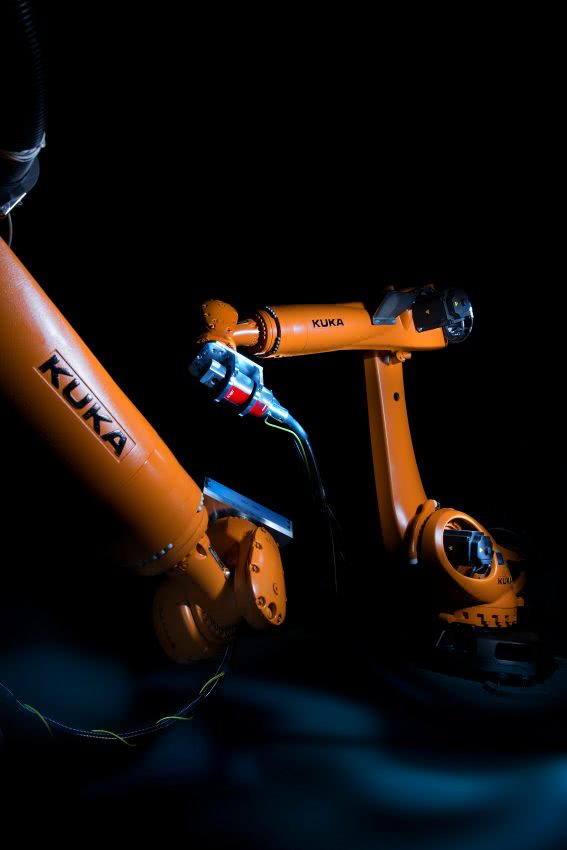
该机器人能够到达具有复杂形状的物体(例如车身)或特别大的工作空间中的测试位置。Fraunhofer EZRT的研究人员开发了RoboCT技术,Fraunhofer EZRT是弗劳恩霍夫集成电路研究所的一个部门。初专门针对航空航天测试,例如检查整个机翼的缺陷,大约13年的研究进入了这项技术,由公共资助和独立的研究项目提供资金。通过与慕尼黑研究与创新中心(FIZ)宝马集团工程师的密切合作,CT系统直接安装在开发和生产之间的接口上,并于2018年7月投入运行。
在他们的设置中,操纵成像组件的四个协作机器人(例如X射线源和探测器)在汽车周围行进,使RoboCT能够到达车辆上的所有位置。通过这种方式,系统可以产生三维CT图像,其显示与人类头发一样小的细节。利用这项技术,可以极其精确地分析物体,而不会损坏物体。到目前为止,执行此级别的分析需要在单独的CT系统中拆卸甚至切割和分析相关组件。较短的开发周期意味着用户可以更快地将产品从创意阶段推向市场。
算法纠正机器人的不准确性
工业中常用的X射线CT系统能够扫描直径约30厘米的物体,以获取所有结构的3D信息,无论这些信息是表面的还是隐藏在物体的内部。这些CT图像可以在计算机上虚拟切片成任何所需的截面图并进行分析。需要超精密硬件组件才能实现有时小于1微米的分辨率。大型工业机器人 - 这里的范围为3米或更大 - 让用户可以在更大的物体和形状复杂的物体上到达感兴趣的区域(ROI)。这里涉及的特殊挑战是使用算法直接从记录的测量数据校正机器人的几何不准确性。
这种尺寸的精确的工业机器人在整个工作区域内的精度仅为?至?毫米 - 但根据应用情况,CT需要至少1/20毫米。解决这个问题是在当今生产环境中使用该技术的关键。
下一步:认知传感器系统
通过这些新发展实现的当前形式的基于机器人的CT只是一个更大想法的开始:长期目标不是简单地随机或批量地测量材料数据,而是仅获取相关数据。至于哪些数据是相关的,认知传感器系统本身将确定这一点。客户将获得类似于高度灵活的黑匣子的东西。他们不需要以任何方式处理它们,并且他们不需要在非破坏性测试中拥有任何专业知识。例如,该盒子将包括可以访问各种自适应传感器系统的机器人,然后,从广泛的意义上说,它们自己决定使用哪种模式以及如何使用它们。然后机器人激活X射线系统,空气超声系统或热成像系统来完成特定的,精确定义的任务,而不仅仅是测试任何东西。通过使用人工智能,RoboCT将通过充当黑匣子来帮助用户完成各种任务,根据手头的工作,在可访问性和获取方面推荐佳参数。
原文如下:
原文如下:
The Fraunhofer Development Center X-ray Technology EZRT has developed “RoboCT,” a robot-assisted computed tomography (CT) system that analyzes vehicle quality in the early development phase of automotive production – without disassembling the vehicle – and thus shortens development cycles. As part of a collaboration with automaker BMW, this system has now been installed in the production environment.
Fraunhofer EZRT puts first robot-based CT system into operation at automaker BMW
This robot is able to reach test positions on objects with complex shapes, such as a car body, or in a particularly large workspace. Researchers at Fraunhofer EZRT, a division of the Fraunhofer Institute for Integrated Circuits IIS, developed the RoboCT technology. Originally aimed especially at aerospace testing, for example to inspect entire wings for defects, some 13 years of research went into this technology, financed both by publicly funded and independent research projects.
In close cooperation with engineers from the BMW Group at the Research & Innovation Centre (FIZ) in Munich, the CT system was installed directly at the interface between development and production, and was put into operation in July 2018.
In their setup, four cooperating robots that manipulate the imaging components, such as the X-ray source and detector, travel around the car, enabling RoboCT to reach all positions on the vehicle. In this way, the system can produce three-dimensional CT images showing details as small as a human hair. With this technology, objects can be analyzed in detail with extreme precision and without damaging them. Until now, performing this level of analysis required the relevant components to be disassembled or even cut out and analyzed in a separate CT system. The shorter development cycles mean that users can take a product from the idea stage to market launch much faster.
Algorithms correct robots’ inaccuracies
X-ray CT systems commonly used in industry are capable of scanning objects of about 30 centimeters in diameter to acquire 3D information on all their structures, whether these are superficial or hidden in the object’s interior. These CT images can be virtually sliced into any desired sectional views on a computer and analyzed. Ultraprecise hardware components are needed in order to achieve resolutions of sometimes less than one micrometer. Large industrial robots – here with ranges of three meters or more – let users reach regions of interest (ROI) on much larger objects and objects with complex shapes. The particular challenge involved here is the use of algorithms to correct the robots’ geometric inaccuracies directly from the recorded measurement data.
The most precise industrial robots of this size achieve accuracies of just ? to ? millimeter over their entire working area – but depending on the application, at least 1/20 millimeter is needed for CT. Solving this problem is the key to using this technology in today’s production environments.
The next step: cognitive sensor systems
The robot-based CT in its current form as realized by these latest developments is just the beginning of a larger idea: the long-term goal is not to simply measure material data at random or in bulk, but rather to acquire only the relevant data. As for which data is relevant, the cognitive sensor system itself will determine that. Customers will receive something akin to a highly flexible black box. They won’t need to deal with it in any way and they don’t need to have any sort of expertise whatsoever in non-destructive testing. The box will include, for instance, robots that have access to various self-adapting sensor systems and that then, in the broadest sense, decide for themselves which modalities to use and how to use them. The robot then activates an X-ray system, an air ultrasound system or a thermography system to complete a specific, precisely defined task, and not merely to test anything. By using artificial intelligence, the RoboCT will assist users with various tasks by functioning as a black box to recommend, depending on the job at hand, optimum parameterizations in terms of accessibility and acquisition.