
 English
 简体中文
简体中文






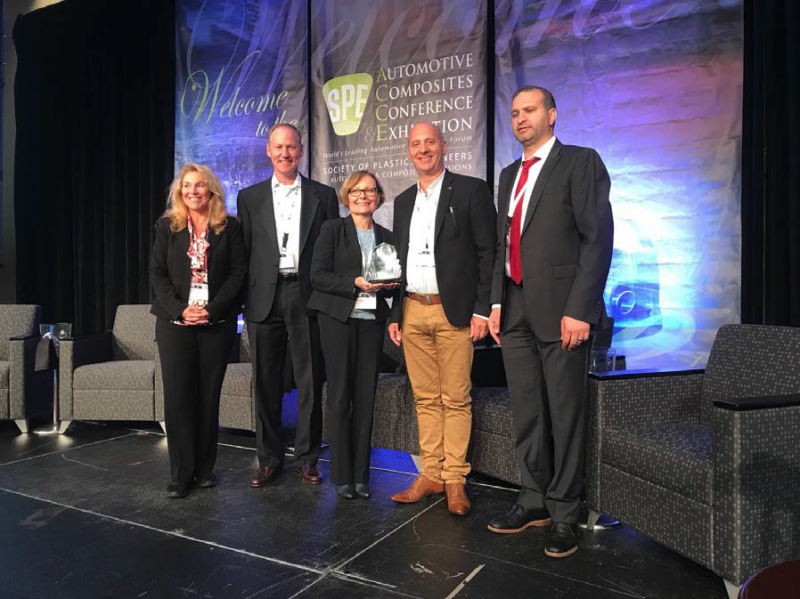
在由塑料工程师协会(SPE)主办的第18届年度汽车复合材料会议和展览(ACCE)上,由汽车制造商雷诺集团(Bouloene-Billancourt,法国)、级Webasto SC(Les Ch Telliers-Chateaumur,法国)、工具制造商和模塑公司AARK-Shapers(法国La SéGuinière)和树脂供应商Polycope Polymers(荷兰Geleen)组成的团队赢得了会议与会者选择的具创新性的组合部件的选择奖。赢得提名的是雷诺(Renault)旗下两款多用途汽车(MPV)-Scenic和Grand Scenic-的全景车顶(全景车顶)上的条组合式导轨。自2016年以来,这两款车型已投入商业生产。威巴斯托和波利奥的代表在闭幕式上接受了这一奖项,并共同提交了一份关于导轨设计和开发的技术论文。
从铝型材向热塑性复合材料的转变降低了零件重量和工作噪音,简化了车辆装配线上的天窗结构和安装,降低了成本,增加了乘客车厢的顶空。Webasto设计了注塑模Rails,使其包括高水平的功能集成,同时减少了零件数量、装配操作和制造时间、成本和复杂性。XIRAN SGH30EB是聚苯乙烯马来酸酐和丙烯腈丁二烯苯乙烯(GR-SMA/ABS)的玻璃纤维增强共聚物,对其进行了优化,既保证了用于将玻璃固定在模子上的聚氨酯胶粘剂的高粘结强度,又保证了模组与白车身(BIW)屋面结构的高尺寸稳定性,并保证了压路机的顺利运行所需的高维稳定性。AARK-Shapers的巧妙工具使天窗模组的8个GR-SMA/ABS复合部件能够在一个家庭工具中模制,该工具还具有模块化块,既允许风景区(五座)和大风景区(七座)钢轨在同一工具中模制,而无需使用昂贵的工具动作(幻灯片)或单独的工具。每根钢轨用两块模压成型,拆卸后用超声波焊接。
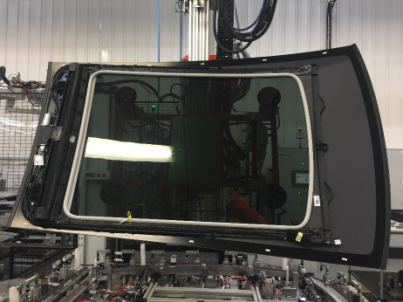
在雷诺的装配厂,新的天窗系统,包括压路机盲,到达完全组装和预测试作为一个整体的单位,是机器人连接到屋顶,消除了二至三个组装步骤,并允许重新分配操作员。初始系统成本降低约20%。然而,新的模块有较少的部件,预计将减少长期保修成本,因为较低的部件/百万(PPM)缺陷和更高的质量已经在雷诺。另一个好处是,Z轴元素栈减少了≈13毫米,因为整个模块是直接粘合到车身白色(Biw)屋顶结构,而不是传统的两到三步的过程,其中的钢轨是用螺丝紧固到BIW,然后模块是固定在轨道上。这不仅为工人在装配线上提供了更多的工作空间,而且在车辆使用期间也给了较高的车辆乘员更多的车顶空间。另外,在遮阳过程中不需要油脂,噪音/振动/粗糙度(NVH)降低。和铝一样,复合钢轨是完全可循环利用的,但初生产它们所需的能源较少,并且在车辆寿命结束时再循环使用。
原文如下:
原文如下:
Renault, Webasto, AARK Shapers and Polyscope developed composite guide rails on a rollerblind sunroof module for the panoramic roof on two models of multipurpose vehicles (MPVs) from Renault called the Scenic and the Grand Scenic.
Renault-Webasto-AARK Shapers-Polyscope team wins 2018 SPE-ACCE people’s choice award for composite sunroof rails
At the 18th-annual Automotive Composites Conference & Exhibition (ACCE) sponsored by the Society of Plastics Engineers (SPE), a team comprised of automaker Groupe Renault (Boulogne-Billancourt, France), tier one Webasto SC (Les Ch?telliers-Chateaumur, France), toolmaker and molder AARK-Shapers (La Séguinière, France), and resin supplier Polyscope Polymers (Geleen, The Netherlands) won the event’s People’s Choice award for the most innovative composite part chosen by conference attendees. The winning nomination was for the first composite guide rails on a rollerblind sunroof module for the panoramic roof on two models of multipurpose vehicles (MPVs) from Renault called the Scenic and the Grand Scenic and have been in commercial production since 2016. Representatives from Webasto and Polyscope accepted the award during closing ceremonies and also co-presented a technical paper on design and development of the guide rails.
The move from aluminium extrusions to thermoplastic composite lowered part weight and operating noise, simplified sunroof construction and installation on the vehicle assembly line, reduced costs, and increased headspace in the passenger compartment. Webasto engineered the injection molded rails to include a high level of functional integration while simultaneously reducing part count, assembly operations, and manufacturing time, cost, and complexity. XIRAN SGH30EB — a fiberglass-reinforced copolymer of styrene maleic anhydride and acrylonitrile butadiene styrene (GR-SMA/ABS) from Polyscope — was optimized both to ensure high bond strength to the polyurethane adhesive used to mount the glass to the module and the module to the body-in-white (BIW) roof structure, and to ensure high dimensional stability critical for smooth operation of the rollerblind. Clever tooling by AARK-Shapers enabled eight GR-SMA/ABS composite parts for the sunroof module to be molded in a family tool that also features modular blocks allowing both Scenic (five-seater) and Grand Scenic (seven-seater) rails to be molded in the same tool without using costly tooling action (slides) or separate tools. Each rail was molded in two pieces and ultrasonically welded after demolding.
Composite guide rails for rollerblind sunroof module
At Renault’s assembly plant, the new sunroof system, including the rollerblind, arrives fully assembled and pretested as a one-piece unit that is robotically bonded to the roof, eliminating two-to-three assembly steps and allowing an operator to be reassigned. The initial system cost reduction is around 20%. However, the new module has fewer parts and is expected to reduce long-term warranty costs as indicated by lower parts/million (PPM) defects and higher quality already seen at Renault. Another benefit is that a Z-axis element-stack reduction of ≈13 mm was achieved because the whole module is adhesively bonded directly to the body-in-white (BIW) roof structure instead of the conventional two-to-three-step process wher rails are fastened with screws to the BIW and the module is then fastened to the rails. This not only provides more working space on the assembly line for workers, but also gives taller vehicle occupants more headspace during vehicle use. Additionally, no grease was needed and noise/vibration/harshness (NVH) was reduced during sunshade operation. Like aluminium, the composite rails are fully recyclable, but less energy is needed to produce them initially and to recycle them at end of vehicle life.