
 English
 简体中文
简体中文




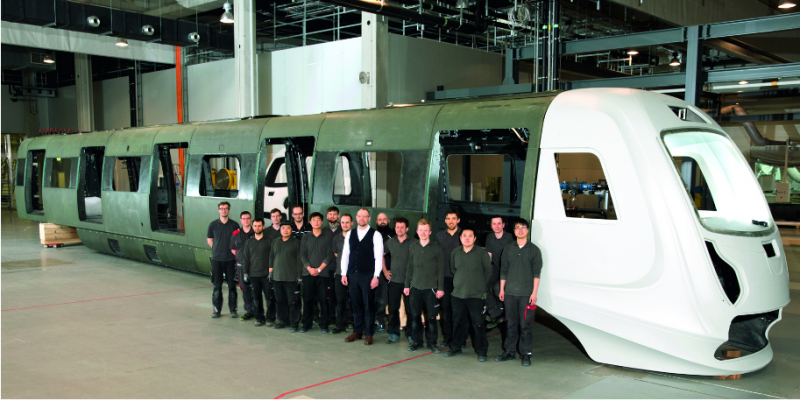
在萨克森州开展的开发工作是CRRC整体“下一代地铁列车”项目的一部分,该项目旨在重新设计公共交通,特别是地下系统,使其更有效、更环保。CG轨道为新一代地铁设计了关键模块,运行前座舱、车体、设备柜和转向架框架子项目,并在此过程中创造出具有创新性和突破性的轻轨车辆部件。
以车体为例,它是由70%的碳纤维增强塑料(CFRP)制成的,与传统的铝结构相比,它的重量减少了30%。除了使用特殊的模拟方法来设计轻量级的结构,这里真正的专长在于创新和新颖的制造技术,为独特的轻量级CFRP-组件。CG钢轨已经成功地开发了拉挤工艺,允许使用不同的纤维类型和纤维取向,高效制造厚达25毫米的大型、单片、多室CFRP型材。这项技术被部署在德累斯顿公司的铁路创新中心(RIC)的一条特殊线路上,用于制造项目所需的22米CFRP型材。
“从技术上讲,我们现在可以制造任何长度的部件。我们目前被限制在77米以内,但这只是由于空间的限制,“安德烈亚斯·乌布利希特博士说,他是CG铁路公司与丁三三的联合席执行官。
Ulbricht博士指出,大型cfrp汽车车身结构的精密连接和装配所需的专用设备也是由cg铁路团队自行开发的,并由总部设在萨克森州的公司制造。
还采用了创新的工艺技术来制造轻型转向架,其四个主要部件,纵梁和横梁,都是由碳纤维布制成的。梁的纺织增强结构初是使用编织或缠绕技术,或两者的结合,然后浸渍树脂,然后硬化使用RTM注射法。该工艺高度自动化,允许极高效、可重复的生产。他们借鉴了德州大学德累斯顿轻量级工程和聚合物技术研究所(ILK)的轻量级设计专业知识。该CFRP转向架框架,是超过百分之四十轻作为其钢当量,可以承受高的负荷,并满足所有的驱动动力学要求。
“CFRP转向架框架在德累斯顿的公认合作伙伴之一确实通过了它的步伐,在一次循环试验中成功地承受了超过正常工作负荷60%的1200万次负荷循环。这相当于超过33年的使用寿命,“Ulbricht博士指出,他描述了上次进行这种疲劳试验。“CFRP转向架框架是一项真正的飞跃创新。”
前舱和设备柜代表了另一个新的基准:包括高达90%的CFRP,他们约30%的重量比可比的金属设计。这使得CG铁路团队能够解决其他问题,包括通过改进功能集成来减少组件的数量。所涉及的创新程度反映在申请的数量上,目前为16项。
除了CG铁路35名德国和员工的技能外,在不到两年的时间里,从初的轮廓设计到四个前舱、三个车体、五个转向架框架和七个设备柜的完成,与德累斯顿轻量级设计的高水平科研和工业专长有很大关系,德累斯顿是现代轻量级设计的摇篮。
“我们能够利用一个特殊的合作伙伴网络,从德国十一所优秀大学之一TU Dresden及其研究所和优秀毕业生,到德累斯顿的许多非大学研究机构(超过10家Fraunhofer研究所、3家Leibniz和Max Planck研究所以及一个Helmholtz中心),到轻量级”家庭“(ILK、LZS GmbH和LSK GmbH)的合作伙伴。与其他地方相比,这里的专业知识集中是CG铁路有限公司在德累斯顿成立的一个关键原因,“Ulbricht博士报告说。
沃纳·哈芬巴赫教授的杰出国际声誉也在这方面发挥了重要作用。20世纪90年代初,他建立了“多材料设计中功能集成系统轻量化建筑”的德累斯顿模型,成为国内外工业的基准。杜德累斯顿轻量级工程和聚合物技术研究所的成立和扩大,Hu芬巴赫教授和他的团队是萨克森轻量级d复兴的推动力。早在1981年,他就一直在组织专题讨论会、讲座和研究项目,以促进与的科学和研究知识的深入交流。这种长期的合作导致了CG铁路有限公司的成立。2017年1月,主席习近平授予科学技术高奖国际科技合作奖,以表彰他对现代系统轻量化设计领域的承诺。
新一代地铁开发项目是的铁路车辆制造商crrc的基准项目,使其能够追随飞机行业的脚步,迫使cfrp轻量化结构在铁路技术中的应用,这将进一步提高城市公共交通的质量。
“通过使用资源高效的轻量级结构尽可能减轻重量是增加有限轴重列车承载能力的一个重要先决条件。它允许更多的乘客在同一个空间内运输,缩短了运行周期,增加了内部舒适性-同时也减少了能源消耗。而这一领域正在产生的研究和开发成果将对其他部门产生协同作用。“CG铁路席执行官丁三三强调。
原文如下:
原文如下:
The innovative lightweight vehicle has been developed by a Chinese-German team of engineers from CG Rail – the Chinese-German Research and Development Center for Rail and Traffic Engineering Dresden – in collaboration with national and international network partners, on behalf of a rolling stock manufacturer, CRRC, from the People’s Republic of China.
A train made of 70 percent carbon-fiber-reinforced plastic components
The development work undertaken in Saxony formed part of CRRC's overall “Next Generation Metro Train” project, which aims to redesign public transport, and underground systems in particular, making it more effective and more environmentally-friendly. CG Rail designed key modules for the new generation metro, running the front cabin, car body, equipment cabinet and bogie frame sub-projects, and creating innovative and groundbreaking lightweight rail vehicle components in the process.
To take the car body as an example, it is made of 70 percent carbon-fiber-reinforced plastic (CFRP), which reduces its weight by 30 percent when compared with conventional aluminum structures. In addition to the use of special simulation methods to design the lightweight structures, the true expertise here lies in the innovative and novel manufacturing technologies for unique lightweight CFRP-components. CG Rail has succeeded in developing pultrusion processes that allow for the efficient manufacture of large, single-piece multi-chamber CFRP profiles with walls up to 25 mm thick using different fiber types and fiber orientations. This technique was deployed on a special line at the Dresden company’s Rail Innovation Center (RIC) to manufacture the 22-meter CFRP profiles required for the project.
“Technically speaking, we can now manufacture components of any length. We are currently limited to 77 meters, but this is only due to space constraints,” says Dr. Andreas Ulbricht, who is joint CEO of CG Rail GmbH with Mr. Sansan Ding.
Dr. Ulbricht points out that the specialized equipment required for the precision joining and assembly of the large CFRP car body structures were also developed in-house by the CG Rail team and built by Saxony-based companies.
Innovative process technologies have also been used to produce the lightweight bogie frame, whose four main components, the longitudinal and cross beams, are made from CFRP. The beams’ textile-reinforced structures are initially produced using braiding or winding technology, or a combination of the two, before being impregnated with resin and then hardened using the RTM injection method. The processes are highly automated and allow for extremely efficient, reproducible production. They draw on the lightweight design expertise of the Institute of Lightweight Engineering and Polymer Technology (ILK) at TU Dresden. The CFRP bogie frame, which is more than 40 percent lighter as its steel equivalent, can withstand the highest loads and meets all driving dynamics requirements.
“The CFRP bogie frame was really put through its paces at one of our recognized partners in Dresden, successfully withstanding twelve million load cycles up to 60 percent in excess of its normal operating load in a cyclic test. This equates to a service life of more than 33 years,” noted Dr. Ulbricht, describing the first fatigue test of its kind to be carried out in the world. “The CFRP bogie frame is a true leap innovation.”
The front cabin and equipment cabinet represent another new benchmark: comprised of up to 90 percent CFRP, they are around 30 percent lighter than comparable metal designs. This has enabled the CG Rail team to tackle other issues, including reducing the number of components through improved functional integration. The degree of innovation involved is reflected in the number of applied patents, which currently stands at 16.
In addition to the skills of the 35 German and Chinese employees of CG Rail, progress from initial outline designs to the completion of four front cabins, three car bodies, five bogie frames and seven equipment cabinets in under two years had a great deal to do with the high level of scientific, research and industrial expertise in lightweight design in Dresden, the cradle of modern-day lightweight design.
“We are able to draw on an exceptional network of partners, from TU Dresden, one of Germany's eleven Universities of Excellence, and its institutes and outstanding graduates, to Dresden’s many non-university research institutes (over ten Fraunhofer Institutes, three Leibniz and Max Planck Institutes and a Helmholtz Center), to partners within the lightweight “family” (ILK, LZS GmbH and LSK GmbH). The concentration of expertise here compared with other locations was a key reason for foundation of CG Rail GmbH in Dresden,” reports Dr. Ulbricht.
Professor Werner A. Hufenbach’s distinguished international reputation also played an important role in this. At the start of the 1990s, he established the Dresden model of “functionally integrated system lightweight construction in multi-material design”, which has since become a national and international industry benchmark. Founding and expanding the Institute for Lightweight Engineering and Polymer Technology at TU Dresden, Professor Hufenbach and his team were the driving force behind the renaissance of lightweight d in Saxony. He was also organizing symposia, lectureships and research projects as long ago as 1981 to promote intensive exchange of scientific and research knowledge with China. This long-standing collaboration led not least to the founding of CG Rail GmbH. In January 2017, he was awarded by Chinese president Xi Jinping with the International Scientific and Technological Cooperation Award, the highest Chinese award for science and technology, in recognition of his commitment to the field of modern system lightweight design.
The new-generation metro development represents a benchmark project for world-leading rolling stock manufacturer CRRC, enabling it to follow in the footsteps of the aircraft industry and force the application of CFRP lightweight structures in railway technology, which will further improve the quality of urban public transport.
“Reducing weight as far as possible through the use of resource-efficient lightweight structures is a vital prerequisite for increasing the loading capacity of trains with limited axle load. It allows more passengers to be transported in the same space, shortens operating cycles and increases interior comfort – as well as using less energy. And the results of research and development being generated in this field will have a synergetic impact on other sectors,” emphasizes Sansan Ding, Chinese CEO of CG Rail.