
 English
 简体中文
简体中文


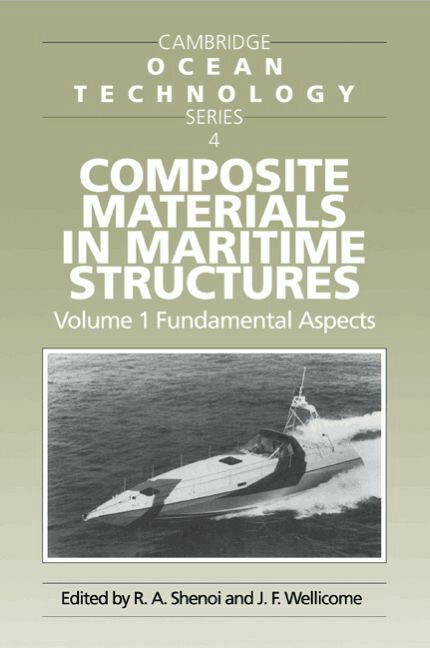
出版社:剑桥大学出版社,1993年版,2008年电子版
内容简介:
剑桥海洋技术系列丛书:
1. Faltinsen: Sea Loads on Ships and Offshore Structures
2. Burcher & Rydill: Concepts in Submarine Design
3. Breslin & Andersen: Hydrodynamics of Ship Propellers
4. Shenoi & Wellicome (eds.): Composite Materials in Maritime Structures, Volume 1, Fundamental Aspects
5. Shenoi & Wellicome (eds.)- Composite Materials in Maritime Structures, Volume 2, Practical Considerations
这套丛书的第四、第五两卷可为船舶与海洋工程应用复合材料提供系统的指南与参考。
第四卷《海洋结构复合材料-基本原理》严谨的阐述了相关理论的发展。涵盖的领域包括材料科学、环境问题、生产工艺、结构分析、有限元方法、材料失效机理和标准测试程序的作用。书的结尾以附录的形式列出了船舶通用聚合物基复合材料和层合板的力学性能。
这套丛书可为从事船舶和海洋工程的学生与研究人员提供快速增长的这一领域的新信息。还是从事相关行业的工程师极具价值的参考书。
目录:
1 A Strategic Overview
1.1 Introduction to Plastics
1.2 Marine Applications
1.3 Materials Technology
1.4 Design Technology
1.5 Production Technology
1.6 The Future
2 Background to Materials Science
2.1 Clarification of What are Composites
2.2 Fibre Selection
2.3 Matrices
2.4 Deformation Limits of FRP
2.5 Optimising of Fibres and Resins
2.6 Core and Sandwich Structures
2.7 References
3 Environmental Aspects
3.1 Introduction
3.2 Durability in a Marine Environment
3.3 Chemical Resistance/Safety and Health
3.4 Fire and Temperature Resistance
3.5 References
4 Production by Resin Transfer Moulding
4.1 Introduction
4.2 The Resin Transfer Moulding Technique
4.3 Fluid Dynamics of the Flow of a Liquid Through a Porous Material
4.4 Mould Filling Process
4.5 The Influence of Mould Flexibility on the Filling Process
4.6 Permeability of Fibre Materials
4.7 Flow Front Simulation
4.8 Production of Moulds with the Vacuum Film Injection Technique
4.9 Preforms
4.10 Variants of the RTM Technique
4.11 Effects of Reaction Shrinkage of the Resin On Surface Quality
Of Products
4.12 Concluding Comments
4.13 References
5 An Engineering Approach to the Prediction of Elastic Properties of a Laminate
5.1 Introduction
5.2 Volumeand Weight Fractions
5.3 Longitudinal Strengt and Stiffness
5.4 Transverse Stiffness
5.5 Prediction of Shear Modulus
5.6 Prediction of Poisson's Ratio
5.7 Alternative Approaches to Prediction of Constants
5.8 Practical Considerations
5.9 References
6 Mechanics of Orthotropic Laminae
6.1 Introduction
6.2 Generalised Hooke's Law
6.3 Material Symmetry
6.4 Engineering Constants
6.5 Relations between Engineering Constants and Stiffness/Compliance
6.6 Plane Stress
6.7 Restrictionson Elastic constants
6.8 Transformation of Elastic Constantsina Plane
6.9 Stress-Strain Variation in a Lamina
6.10 Bibliography
7 AnalysisofLaminatedComposites
7.1 Introduction:Laminate Constructions
7.2 Classical Laminate Theory
7.3 Determination of Laminae Stresses and Strains
7.4 Coupling Effects
7.5 Construction and Properties of Special Laminates
7.6 Hygrothermal Stresses in Laminates
7.7 Interlaminar Stresses and Free Edge Effects
7.8 Bibliography
7.9 References
8 Theory of Sandwich Beams and Plates
8.1 Introduction
8.2 Bending of Beams
8.3 Overview of Regimes of Sandwich Behaviour
8.4 Sandwich Panels(Plates)
8.5 Sandwich Panel(Plate) Equations
8.6 References
9 Design of Anisotropic Panels
9.1 Introduction
9.2 Loading and Load Factors
9.3 Design of Panels under Lateral Load
9.4 Design of Panels under In-Plane Loading
9.5 Design of Panels under Shear Loading
9.6 Combined Loading
9.7 References
10 Finite Element Analysis of Composites
10.1 Introduction
10.2 Background to FE Techniques
10.3 TheStifftiess Method
10.4 Matrices for Typical Elements
10.5 Higher Order/Complex Elements
10.6 References
11 Theoretical Predictions of Failure Mechanisms and Strength
11.1 Introduction
11.2 Unidirectional Composites
11.3 Plain Laminates
11.4 Laminates with Stress Concentrations
11.5 Fatigue and Environmental Effect
11.6 Conclusions
11.7 Acknowledgements
11.8 References
12 Considerations of Failure Theories in Designs
12.1 Introduction
12.2 Failure Theories and Criteria
12.3 Failurein Single Skin Laminates
12.4 Sandwich Structures
12.5References
13 Test
13.1 Introduction
13.2 Standards Development and Validation
13.3 Test Panel and Specimen Manufacture
13.4 Component Fractions and Thickness Measurement
13.5 Tensile Properties
13.6 Compressive Properties
13.7 Flexural Properties
13.8 Interlaminar Shear Properties
13.9 In-Plane Shear Properties
13.10 Sandwich Material Properties
13.11 Environmental and Long-Term Test Conditions
13.12 Discussion
13.13 References
Appendix
更多信息请关注复材网www.cnfrp.com